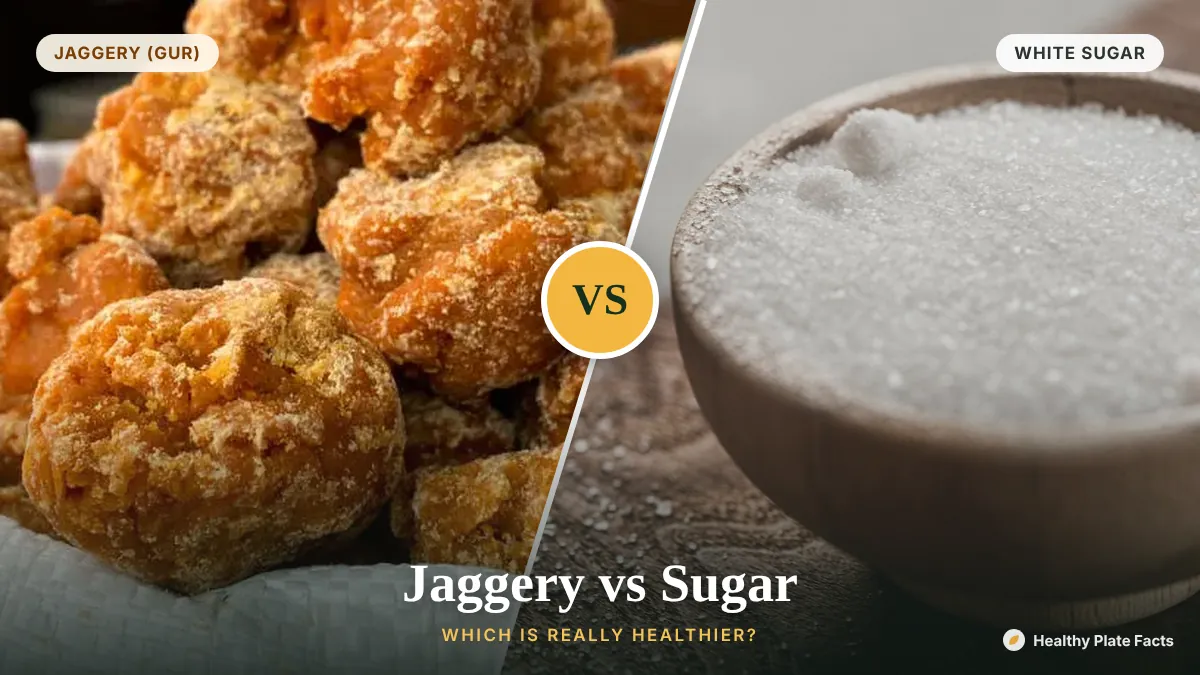
Is jaggery healthier than sugar? Only slightly, and not in the way most people hope. Gram for gram, jaggery (gur) has almost the same calories as white sugar: 354 kcal per 100 g against 387 kcal [1][2]. It also carries small amounts of iron, calcium, magnesium and potassium that refined sugar lacks. But at the one or two teaspoons most of us use, those minerals add very little, and your body handles jaggery much like any other sugar. In the jaggery vs sugar debate, the honest answer is that both are added sugar and both need limiting.
Walk through any North Indian market in November and you will see it: golden-brown cones and blocks of fresh gur stacked beside heaps of peanuts and til. Winter is jaggery season. Families switch from sugar to gur in their chai, make gajak and chikki, and finish a heavy meal with a small piece "for digestion". Many people make the switch because they have heard gur is healthy, iron-rich, even good for diabetes.
Some of that is true, some is exaggerated, and some is simply wrong. This guide compares jaggery and sugar using India's own food composition data and the latest guidelines from WHO and ICMR-NIN, so you can decide how to use each one.
What is jaggery, and how is it different from sugar?
Jaggery is a traditional unrefined sweetener made by boiling sugarcane juice (or date or palm sap) in open pans until it thickens, then cooling it into blocks, cones or powder. Scientists call it a non-centrifugal sugar, because the molasses is never spun out in a centrifuge [3]. That is why it keeps its brown colour, caramel flavour and some minerals. India produces more than 70% of the world's jaggery [14].
White sugar comes from the same cane juice, but it is clarified, crystallised and spun in a centrifuge to separate the molasses. The result is almost pure sucrose: about 99.8 g of sugars per 100 g [2].
Jaggery vs sugar: nutrition per 100 g
The table below uses the Indian Food Composition Tables 2017 (IFCT, ICMR-NIN) for cane jaggery and USDA FoodData Central for granulated white sugar. Both are lab-analysed reference values.
| Nutrient (per 100 g) | Jaggery, cane (IFCT 2017) [1] | White sugar (USDA) [2] |
|---|---|---|
| Energy | 354 kcal (1,480 kJ) | 387 kcal |
| Carbohydrate | 84.9 g | 100 g |
| Water | 11.2 g | ~0 g |
| Protein | 1.85 g | ~0 g |
| Iron | 4.63 mg | 0.05 mg |
| Calcium | 107 mg | 1 mg |
| Magnesium | 115 mg | 0 mg |
| Potassium | 488 mg | 2 mg |
| Phosphorus | 75 mg | not listed |
| Sodium | 25 mg | 1 mg |
| Zinc | 0.45 mg | not listed |
| Folate | 14.4 µg | not listed |
What this looks like in a real serving
Nobody eats 100 g of gur at a time. A more realistic amount is 10 g, roughly two level teaspoons of jaggery powder or a small piece after lunch. Here is what 10 g gives you, calculated from the table above:
- Jaggery (10 g): about 35 kcal, 0.46 mg iron, 11 mg calcium, 49 mg potassium.
- White sugar (10 g): about 39 kcal, almost no minerals.
So yes, jaggery wins on minerals. But 0.46 mg of iron is under 2% of the 29 mg a day that ICMR-NIN recommends for adult Indian women, and about 2.4% of the 19 mg recommended for men [6]. To get a woman's full day of iron from jaggery alone, you would need to eat over 600 g, which is more than 2,200 kcal of sugar.
Is jaggery healthier than sugar? The benefits, one by one
1. It contains more minerals than white sugar
Evidence: Strong (for the composition itself). Lab analyses consistently show that jaggery contains iron, calcium, magnesium, potassium and some B vitamins, while refined sugar contains almost none [1][2][3]. The catch is quantity. At normal serving sizes the extra minerals are small, and a varied diet of pulses, nuts, seeds and vegetables is a far better way to get them.
2. It may help with iron intake, but it will not fix anaemia
Evidence: Preliminary. Anaemia is a serious public health problem in India. The National Family Health Survey (NFHS-5, 2019–21) found that 57% of women aged 15–49 and 67.1% of children aged 6–59 months were anaemic [7]. It is easy to see why "eat gur for iron" became popular advice.
But we found no good-quality human trial showing that eating jaggery improves haemoglobin or treats anaemia. Iron from plant foods (non-haem iron) is also absorbed less well than iron from meat, fish and eggs. NIH notes that absorption from vegetarian diets is about 5–12%, and that vitamin C improves it [8]. Gur and roasted chana is a fine traditional snack, but for anaemia the answer is a varied iron-rich diet plus medical testing and treatment, not more sugar.
3. "Gur cleans the lungs": what the study actually showed
Evidence: Preliminary (animal study only). This popular claim traces back to a 1994 study in rats [9]. Researchers put coal dust into the rats' lungs and fed some of them jaggery for 90 days. The jaggery-fed rats moved more dust particles out of the lungs into lymph nodes and had fewer lung lesions. That is an interesting result, but it was in animals, at high doses relative to body weight, and it has not been confirmed in people. There are no human trials showing jaggery protects against air pollution, smoking or occupational dust. If you live in a high-pollution city, masks, air purifiers and medical care matter far more than gur.
4. A traditional digestive after meals
Evidence: Traditional use. Eating a small piece of gur after lunch or dinner is a long-standing habit across India, and gur has a long place in Ayurvedic tradition. Government material on jaggery describes such uses as traditional beliefs rather than proven effects [14]. We found no clinical trials testing jaggery for digestion. If a small piece after a meal satisfies your sweet craving instead of a larger dessert, that is a reasonable habit. Just count it as sugar.
5. It is less processed
Evidence: Strong (for the process). Jaggery is made by boiling and concentrating cane juice, without the centrifuge and refining steps used for white sugar [3]. Many people prefer it for this reason, and for its deeper flavour. "Less processed" does not mean "low sugar", though. Jaggery is still roughly 85% carbohydrate, almost all of it sugar [1][3].
Jaggery and diabetes: is gur safe if you have high blood sugar?
No. This is the most important myth to correct. Jaggery is mainly sucrose plus some glucose and fructose [3], and these sugars raise blood glucose whether they come from a gur block or a sugar bowl. Published glycaemic index data for jaggery are limited and inconsistent. A small trial to measure the glycaemic index of different jaggery types was registered in Pakistan in 2025, but no results have been posted [12]. There is no reliable evidence that jaggery is gentler on blood sugar than white sugar.
If you have diabetes or prediabetes, treat jaggery, honey, brown sugar and white sugar the same way: as sugar to keep to a minimum, within the plan agreed with your doctor or dietitian. If you want to explore foods with real human evidence for blood-sugar control, our guide to methi seeds benefits looks at the clinical trials.
How much jaggery or sugar is safe per day?
Health authorities do not set separate limits for jaggery. It falls under added or free sugars, along with white sugar, honey and syrups.
- ICMR-NIN (India, 2024): keep sugar under 5% of daily energy, which is about 20–25 g a day for adults, and give no added sugar to children under two [5].
- WHO: keep free sugars under 10% of energy, with further benefit below 5%, or roughly 25 g (6 teaspoons) a day [4].
- NHS (UK): no more than 30 g of free sugars a day for adults, with lower limits for children by age [10].
Those 20–25 g cover all added sugar in your day, including what is already in biscuits, sweets, cold drinks and packaged foods. In practice, that leaves room for a little gur in your chai or one small piece of chikki, not both plus dessert.
How to use jaggery sensibly in an Indian kitchen
- Use it for flavour, not volume. Jaggery's caramel taste works well in small amounts: a little in sambar, rasam, Gujarati dal or tamarind chutney balances sourness.
- Pair it with nutrient-dense foods. Til chikki, peanut gajak and gur-chana come with protein, fibre and minerals from the nuts, seeds and pulses. Our guide to sesame seeds benefits covers til.
- Cut the total, then choose. Reduce how much sweetener goes into your chai first. Then pick gur if you prefer its taste.
- Add vitamin C for iron. If you are eating iron-rich foods, pair them with vitamin C sources such as amla, guava or lemon, which helps absorption [8]. See our amla benefits guide.
- Store it dry. Jaggery absorbs moisture and can go sticky or mouldy. Keep it in an airtight jar in a cool place.
Side effects and who should limit jaggery
- People with diabetes or prediabetes: jaggery raises blood sugar like sugar. Follow your doctor's advice.
- Anyone managing weight: at about 35 kcal per 10 g, jaggery calories add up fast in sweets and chai.
- Babies under two: ICMR-NIN advises no added sugar at all for this age, and that includes jaggery [5].
- Dental health: sticky sweets like chikki and gur cling to teeth. Rinse or brush afterwards.
- People with kidney disease: jaggery contains notable potassium (488 mg per 100 g) [1], which matters for anyone on a potassium-restricted diet. Ask your nephrologist.
- Quality concerns: adulterated or poorly stored gur can contain added chemicals or mould. Buy from licensed sellers.
Frequently asked questions
Is jaggery better than sugar for weight loss?
Not meaningfully. Jaggery has about 354 kcal per 100 g against 387 kcal for white sugar [1][2], a small difference that disappears if you use a bit more gur to get the same sweetness. For weight loss, using less added sugar overall matters far more than the type.
Can diabetics eat jaggery instead of sugar?
Jaggery is not a diabetic-friendly sugar. It is mostly sucrose and raises blood glucose [3]. People with diabetes should limit it the same way they limit sugar, and follow their doctor's or dietitian's guidance.
Does jaggery increase haemoglobin?
There is no good human evidence that jaggery raises haemoglobin. It contains some iron (4.63 mg per 100 g) [1], but realistic servings provide very little. Anaemia needs proper diagnosis and treatment.
How much jaggery can I eat in a day?
Count it within your total added sugar. ICMR-NIN suggests keeping all added sugar to about 20–25 g a day for adults [5], so one small piece (about 10 g) or two teaspoons of jaggery powder is a sensible upper amount if you eat little other sugar.
Is jaggery tea healthier than sugar tea?
Only marginally. Gur chai has a tiny amount of extra minerals, but the calorie and sugar load is similar. The healthier move is to reduce how much sweetener goes into each cup.
Is jaggery good in winter?
Winter is when fresh jaggery is made and when Indian sweets like til laddoo and gajak are eaten, so it is a seasonal tradition. The idea that gur "warms the body" is traditional belief, not something clinical research has tested. Enjoy it in small amounts as part of seasonal foods.
Is brown sugar the same as jaggery?
No. Brown sugar sold in shops is a different, usually refined product. Jaggery is unrefined, with the molasses never removed [3]. Both still count as free sugars [10].
The verdict: jaggery vs sugar
Jaggery is a little better than white sugar: it is less processed, carries trace minerals and has a richer flavour that may let you use less. But it is not a health food, not an iron supplement and not safe for diabetes in large amounts. The best choice in any Indian kitchen is to sweeten less overall, and when you do, choose the sweetener whose taste you enjoy, gur included.
Helpful products we'd consider
We may earn a small commission if you buy through these links, at no extra cost to you. We only suggest products that fit the advice in this article. As an Amazon Associate I earn from qualifying purchases. Learn more.
Organic jaggery powder (FSSAI-licensed)
Easier to measure than block gur, so portions stay small.
See jaggery powder on Amazon.inDigital kitchen scale
Weigh 10 g once and you will know what a sensible portion looks like.
See kitchen scales on Amazon.inAirtight glass storage jars
Keeps jaggery dry so it does not turn sticky or mouldy.
See glass jars on Amazon.inReferences
- Longvah T, Ananthan R, Bhaskarachary K, Venkaiah K. Indian Food Composition Tables 2017. ICMR–National Institute of Nutrition, Hyderabad. Food code I001, Jaggery, cane. nin.res.in
- US Department of Agriculture. FoodData Central: Sugars, granulated (SR Legacy, FDC ID 169655). fdc.nal.usda.gov
- Rao PVKJ, Das M, Das SK. Jaggery – a traditional Indian sweetener. Indian Journal of Traditional Knowledge. 2007;6(1):95–102. nopr.niscpr.res.in
- World Health Organization. WHO calls on countries to reduce sugars intake among adults and children. 4 March 2015. who.int
- ICMR–National Institute of Nutrition. Dietary Guidelines for Indians, 2024. nin.res.in
- ICMR–National Institute of Nutrition. A Brief Note on Nutrient Requirements for Indians: Recommended Dietary Allowances and Estimated Average Requirements, 2020. nin.res.in
- Ministry of Health and Family Welfare, Press Information Bureau. NFHS-5 findings on anaemia. 4 February 2022. pib.gov.in
- NIH Office of Dietary Supplements. Iron: Fact Sheet for Health Professionals. ods.od.nih.gov
- Sahu AP, Saxena AK. Enhanced translocation of particles from lungs by jaggery. Environmental Health Perspectives. 1994. PMID 7882934. pmc.ncbi.nlm.nih.gov
- NHS. How does sugar in our diet affect our health? nhs.uk
- Harvard Health Publishing. The sweet danger of sugar. Updated 2026. health.harvard.edu
- ClinicalTrials.gov. Comparative Evaluation of Glycemic Index of Different Types of Jaggery Produced Locally in Pakistan (NCT07015814). clinicaltrials.gov
- Business Today. Buying jaggery? This simple FSSAI-approved home test can help check its purity. 14 August 2026. businesstoday.in
- Press Information Bureau. The Superfood Sweetener: Jaggery Production and Processing in India (Backgrounder). 16 May 2026. pib.gov.in